Article originally posted by The Avery Journal Times on Oct 29, 2025
by Christian Gardner christian.gardner@averyjournal.com
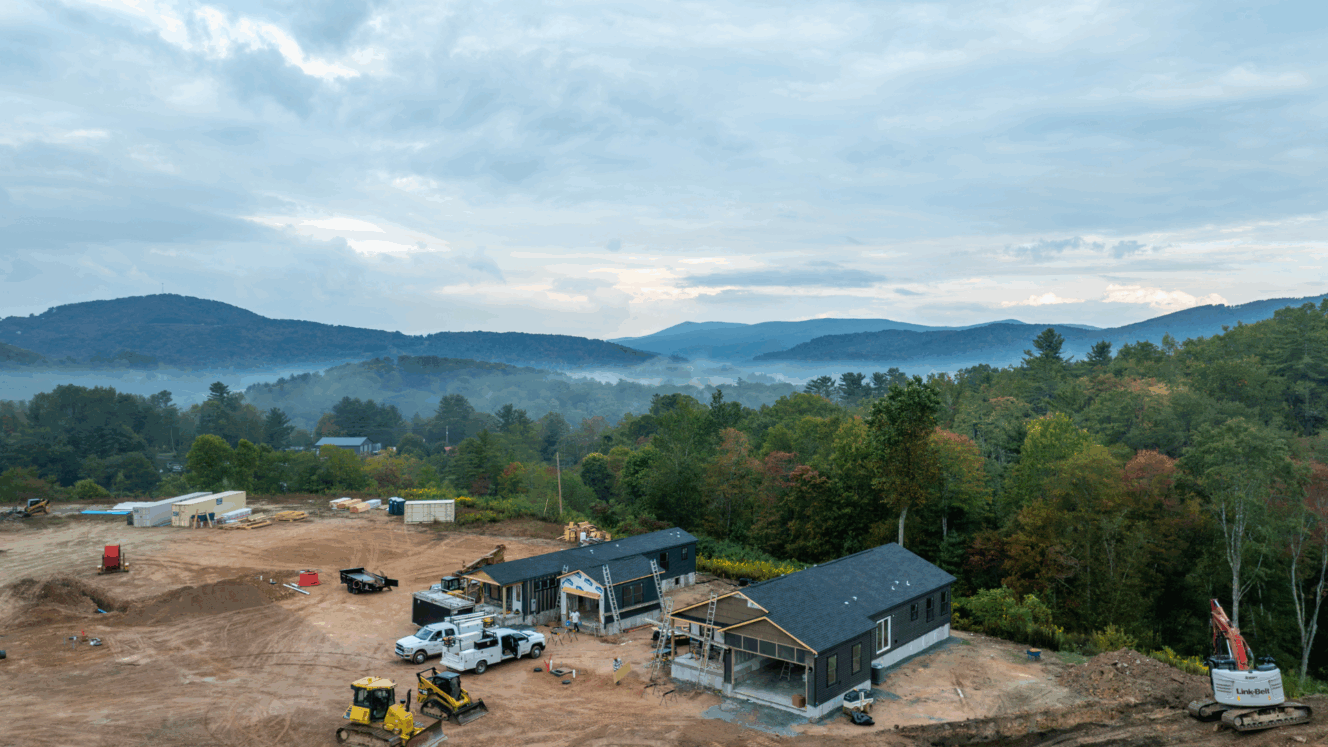
NEWLAND — Just outside of Newland, the quiet hum of construction fills the air at what’s quickly becoming one of Avery County’s most talked-about projects, the Chief Cares “Blue Haven.” Rows of newly set homes, still shining with that “just delivered” look, now line the small hillside where families will soon begin a brand new chapter.
Blue Haven isn’t just another neighborhood; it’s a symbol of recovery and resilience. The development is the first of its kind in the area, and first major housing effort under Chief Cares, the charitable foundation created by country artist Eric Church and his wife Katherine. After Hurricane Helene left lasting damage across the High Country, Chief Cares set out to help families who lost nearly everything find stability again.
Nine families have already been chosen for the first phase of the project, and 29 more homes will soon be filled as the next round of selections wraps up early next year, which were celebrated in a recent block party event Chief Cares hosted at the Avery Community Building.
The homes themselves are part of a unique partnership between Chief Cares and Clayton Homes, one of the nation’s top builders of manufactured housing. Each unit arrives as a factory-built Clayton model, designed, inspected and finished to permanent residential standards before being placed on-site.
“These are not temporary units,” said Thomas Johnson, Associate Executive Director for Chief Cares. “They’re full-size homes, built to last, with modern layouts and energy-efficient systems. The goal is to give families something truly permanent.”
Most of the homes follow a three-bedroom, two-bath layout spanning just more than 1,600 square feet. A handful of two-bedroom models and several four-bedroom options round out the mix for smaller and larger families alike. Each features wide-plank flooring, nine-foot ceilings, and modern finishes, with four interior color schemes so every family’s home feels unique. Exteriors are done in mountain-toned shades of dark gray, green and brown, accented with bark-style or shingle trim that blends naturally into the local landscape.
Each home features fully functional kitchens, dining room, large laundry room and roomy closets in each bedroom. Each home also comes fully furnished, yet another perk for families receiving said opportunity.
Every house will included a garage, a front porch and either a side or rear deck depending on lot placement. Built with Clayton’s newest efficiency standards, each home is heated and cooled by an advanced heat-pump system, keeping energy costs low while offering year-round comfort.
“We wanted the homes to fit the area: practical, attractive, and built for the climate,” Johnson said. “Katherine really went above and beyond to make sure these homes were going to feel like home to the families that’ll receive them. Including the nine-foot ceilings, garage and more, she was very outspoken about making sure families were accommodated.”
But beyond the siding and square footage, what really sets Blue Haven apart is the model itself, how these homes are being offered, and to whom. Early on, Chief Cares discussed short-term rental assistance or discounted sales. As plans evolved, however, the focus shifted to long-term stability and ownership.
This is the organization’s first project of this size, and they admit they’re learning as they go. In many instances, organizations that do similar projects have years to establish and find what works. With this being something completely new, the organization is working effectively to make sure everything flows and is suitable for those set to receive.
Families selected to live in Blue Haven will enter a 10-year lease-to-own agreement designed to prevent house flipping and ensure each home remains part of the community. After those 10 years and one day, the deed transfers to the family, free and clear.
“We wanted people to feel ownership from day one,” Johnson said. “There’s no mortgage, no interest and no debt. It’s their home, permanently.”
During that 10-year term, residents pay a modest monthly operations fee that covers the essentials such as lawn care, trash pickup, snow removal, property taxes, insurance, bush trimming, pressure washing and road maintenance. The fee, however, does not go to Chief Cares directly, but to a property-management group that maintains the neighborhood. Families handle their own utilities but otherwise live “rent-free” of major maintenance costs.
“The idea is to give people time to breathe,” Johnson said. “They can focus on family instead of worrying about repairs and upkeep.”
To help families succeed long-term, Chief Cares is also partnering with a financial-counseling program that will work directly with residents throughout the 10-year term. The program offers budget planning, credit repair and home-ownership education to help families manage finances and prepare for life after they take full ownership of their homes.
“We want this to be generational,” Johnson said. “These families aren’t just getting a roof. They’re getting the tools to build stability.”
That impact, Johnson noted, will stretch far beyond the adults moving in.
“Kids see this,” he added. “They see their parents working toward something, finally able to provide a home, and it changes the way they see the world. It builds hope.”
The vetting process for residents has been both careful and community-driven. Applicants go through multiple stages including background checks, local references and financial screening to ensure each family is a good fit. Chief Cares relied heavily on local vetting partners, schools, churches and community leaders who helped review applicants to make sure selections represented the best of Avery County.
Johnson said the first part of the process is a pre-qualification questionnaire, which works as a filtering mechanism.
“It gives us an idea of who’s interested, but it also helps applicants see what’s required,” he explained. “If someone marks ‘no’ to things like background checks, they’re automatically filtered out. It’s objective and fair.”
Not everyone who applied was a fit, and Johnson emphasized that’s not a bad thing.
Some people already owned their land and understandably didn’t want to move. Others simply weren’t interested in living in an HOA setting, and that’s perfectly fine,” he said. “Those folks were often helped through other organizations like Appalachia Service Project, Samaritan’s Purse, or Volunteer Avery. Chief Cares was never meant to replace those efforts. It’s just another avenue to help.”
That “other avenue” focuses particularly on people who’ve fallen between the cracks, such as renters, working families, and those who lost homes they didn’t own.
“Renters were hit hardest after Helene,” Johnson said. “Homeowners could sometimes rebuild with insurance or FEMA, but renters had nowhere to go. That’s where we stepped in.”
Johnson also addressed early confusion about the project’s “pillars” concept.
“Pillars doesn’t mean power or politics,” Johnson said. “It means the people who keep a community standing, the teachers, healthcare workers, mechanics, linemen and others who serve every day.”
Each home sits on roughly one-third of an acre, giving families room to breathe but maintaining a close-knit, neighborhood feel. There will be an HOA, but Johnson said it’s built on reasonable restrictions.
“You can have pets, you can grill on the porch, you can park your work vehicle,” he said. “We just ask folks to take pride in where they live.”
Applications for the next round are open now at chiefcares.org, and already more than 150 families have submitted pre-qualifications. Those who meet the criteria move on to the full application process, which takes about six weeks and includes both local and outside evaluations to ensure fairness.
“We don’t just handpick people,” Johnson said. “It’s objective, transparent and guided by heart and data both.”
Funding for the project stems from Eric Church’s “Concert for Carolina,” which raised roughly $24 million last fall. The concert was a joint effort between Church and fellow North Carolina native Luke Combs, with each artist receiving approximately $12 million to direct toward their respective recovery initiatives. Church dedicated his half entirely to Chief Cares and Blue Haven.
“$12 million sounds like a huge number,” Johnson said. “But when it comes to building homes and creating lasting housing, it doesn’t stretch far. That’s what makes this even more special. It’s proof of what’s possible when you focus every dollar on people, not profit.”
The next 29 families are expected to be selected after the new year, with move-ins beginning by late spring 2026. When completed, Blue Haven will include 38 homes, serving more than 100 residents, all privately funded through donations, partnerships and the continued efforts of Chief Cares.
John Blackburn, executive director of Chief Cares, said the project stands as a reminder of what can happen when compassion meets action.
“It’s not just about replacing what was lost,” Blackburn said. “It’s about restoring hope and keeping the people of Avery County right here, where they belong.”